The microwave backbone acts as the essential foundation for surveillance and edge services, providing dependable data transport throughout MODON’s varied industrial environment.
This case study details the robust microwave communication infrastructure implemented across MODON industrial cities to support a unified surveillance ecosystem. The carrier-grade network utilizes a layered architecture comprising field, access, aggregation, and backhaul layers to transport high-bandwidth surveillance traffic. Deployed across 30 sites, the infrastructure includes 191 poles and 342 microwave links.

- Industry Type
- Government
- Company Size
- Large
- Number of Employees
- 20,000
- Location
- Riyadh, Saudi Arabia
This case study documents the actual deployed microwave communication infrastructure implemented for MODON industrial cities, with emphasis on network topology, site counts, pole distribution, microwave link quantities, and integration logic rather than theoretical principles.
Where exact quantities cannot be conclusively derived from the provided datasets, explicit placeholders are intentionally left, clearly referencing the relevant Excel source so that values can be manually inserted without risking inaccuracy.
The microwave network acts as the primary transport layer interconnecting field poles, aggregation sites, and MODON core network points.
Project Objectives
MODON industrial cities are geographically distributed and vary significantly in terrain, scale, and infrastructure readiness. A unified surveillance and monitoring ecosystem required a common, carrier-grade communication backbone capable of:
Supporting high-bandwidth video surveillance traffic
Operating across urban, semi-urban, and remote environments
Enabling phased expansion across multiple cities
Maintaining high availability under adverse environmental conditions
Total Sites
Total Field Posts
Deployment Phases
Layered System Architecture
Core Integration Layer
Handover to the MODON network and control room infrastructure.
Control Room
Backhaul Layer
Long-haul microwave links provide connectivity between cities, zones, or major aggregation points.
Access and Aggregation Layer
Microwave links aggregating traffic from multiple poles toward higher-capacity nodes.
Field Layer
Microwave links aggregating traffic from multiple poles toward higher-capacity nodes.
Surveillance Devices
Microwave Terminals
Mounting Structures
Power Systems and Grounding
Equipment Integrated from Vendors
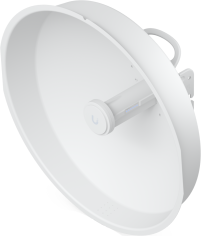
338
Ubiquiti airMAX PowerBeam 5AC ISO
Ubiquiti PowerBeam 5AC ISO is a high-performance 5 GHz wireless bridge. Designed by Ubiquiti Networks, it creates incredibly fast and reliable, long-range Point-to-Point (PtP) or Point-to-Multi-Point (PtMP) network connections spanning up to 25+ kilometers
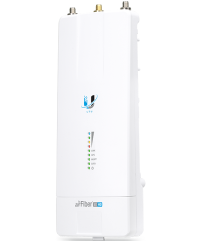
55
Ubiquiti airFiber AF-5XHD
Ubiquiti airFiber AF-5XHD is a powerful 5 GHz carrier backhaul radio designed for long-range, high-speed Point-to-Point (PtP) wireless links. It is heavily used by Wireless Internet Service Providers (WISPs) to bridge connections over large distances.

2
Ubiquiti airFiber AF-24HD
Ubiquiti airFiber AF-24 HD is a high-performance, point-to-point wireless bridge that delivers gigabit+ data connections. Operating in the license-free 24 GHz frequency band, it is designed to bridge networks across large distances without the need for expensive physical fiber optic cables.
Pole and Site Infrastructure Design
Pole Distribution
The project includes distributed surveillance and communication poles deployed across MODON cities. Pole Roles include:
- Access poles (single-hop microwave)
- Aggregation poles (multi-link termination)
Each pole is uniquely identified and geographically mapped, enabling precise LOS validation for microwave paths.
Total Poles Deployed
Equipment Installed per Pole
Each pole is engineered to support the following equipment stack:
- Microwave radio unit(s): 1–2 per pole (depending on hop count)
- Microwave antenna(s): 1–2 directional parabolic antennas
- Surveillance devices: 1153 in total sites
- Outdoor-rated cabinet with power distribution
- Earthing and lightning protection system
Actual per-pole variations are documented in the pole inventory sheet.
Surveillance Devices Deployed
Power and Grounding
Dedicated Power Feed per Pole
Surge Protection Devices (SPD)
Single-Point Grounding bonded to Pole Structure
Microwave Network Design
Topology and Link Quantities
The microwave network is implemented using point-to-point LOS links, with aggregation occurring at designated poles and sites. Single and Multi hop links are designed to funnel traffic from field poles toward higher-capacity aggregation sites and onward to the MODON core.
Total Microwave Links
Frequency Band Utilization
- Lower-frequency bands applied for longer hops
- Higher-frequency bands applied for short, high-capacity hops
Frequency reuse planning is applied across cities to optimize spectrum utilization.
Microwave Radio and Antenna Engineering
Radio Characteristics
Microwave radios deployed across the network exhibit the following typical characteristics:
- Full-duplex operation using FDD
- Adaptive modulation from low-order QPSK to high-order QAM
- Channel bandwidths sized to support aggregated surveillance traffic
- Support for adaptive transmit power control (ATPC)
Adaptive features allow links to maintain connectivity under varying weather and interference conditions.
Antenna Systems
Highly directional parabolic antennas are used to:
- Maximize link budget
- Minimize interference
- Support high spectral efficiency
Key antenna parameters considered during design include gain, beamwidth, polarization, and cross-polar discrimination.
Capacity Planning and Traffic Engineering
Traffic Sources and Quantities
Primary traffic sources include surveillance devices deployed at field poles.
Total Cameras (all types)
Bandwidth Engineering
Microwave link capacities are selected based on aggregated traffic:
- Estimated bitrate per camera
- Aggregated bitrate per pole
- Aggregated bitrate per microwave hop
Each link includes headroom to support peak load and future expansion.

Propagation, Environment, and Reliability Engineering
Line-of-Sight and Fresnel Clearance
All microwave paths were engineered to maintain:
- Clear optical LOS
- At least 60% first Fresnel zone clearance under worst-case conditions
Terrain data and on-site surveys were used to validate assumptions.
Environmental Effects
The design accounts for:
- Rain attenuation, particularly at higher frequencies
- Temperature-induced equipment stress
- Wind loading on antennas and poles
Key antenna parameters considered during design include gain, beamwidth, polarization, and cross-polar discrimination.
Availability Targets
The network was designed to meet carrier-grade availability targets, typically in the range of:
- 99.99% to 99.999%, depending on link criticality
Availability modeling follows established methodologies such as ITU-R P.530.

Integration with MODON Core Network
Standard IP routing and VLAN segregation are applied to isolate surveillance traffic from other services.
Microwave aggregation nodes interface with the MODON IP network
Centralized monitoring and control systems terminate at core locations
Operations, Monitoring, and Maintenance
Design standardization across sites simplifies operations and reduces mean time to repair (MTTR). The microwave infrastructure supports:
Continuous link performance monitoring
Remote fault detection and diagnostics
Preventive maintenance planning

Scalability and Future Expansion
This positions the infrastructure to support future surveillance growth and additional smart infrastructure services. The network is inherently scalable:

Additional poles and links can be introduced without redesigning the core
Higher-order modulation and wider channels can increase capacity
Redundant paths can be added to enhance resilience
Conclusion
The MODON microwave communication infrastructure provides a robust, flexible, and high-availability transport backbone tailored for large-scale, distributed industrial environments. Through disciplined engineering, conservative reliability planning, and phased deployment, the system successfully supports present operational requirements while remaining adaptable for future expansion.
The microwave backbone serves as the critical enabler upon which surveillance systems and other edge services are built, ensuring reliable data transport across MODON’s diverse industrial landscape.